Physical lottery or online: what are the real differences?

Sep 22, 2026

Sep 22, 2026
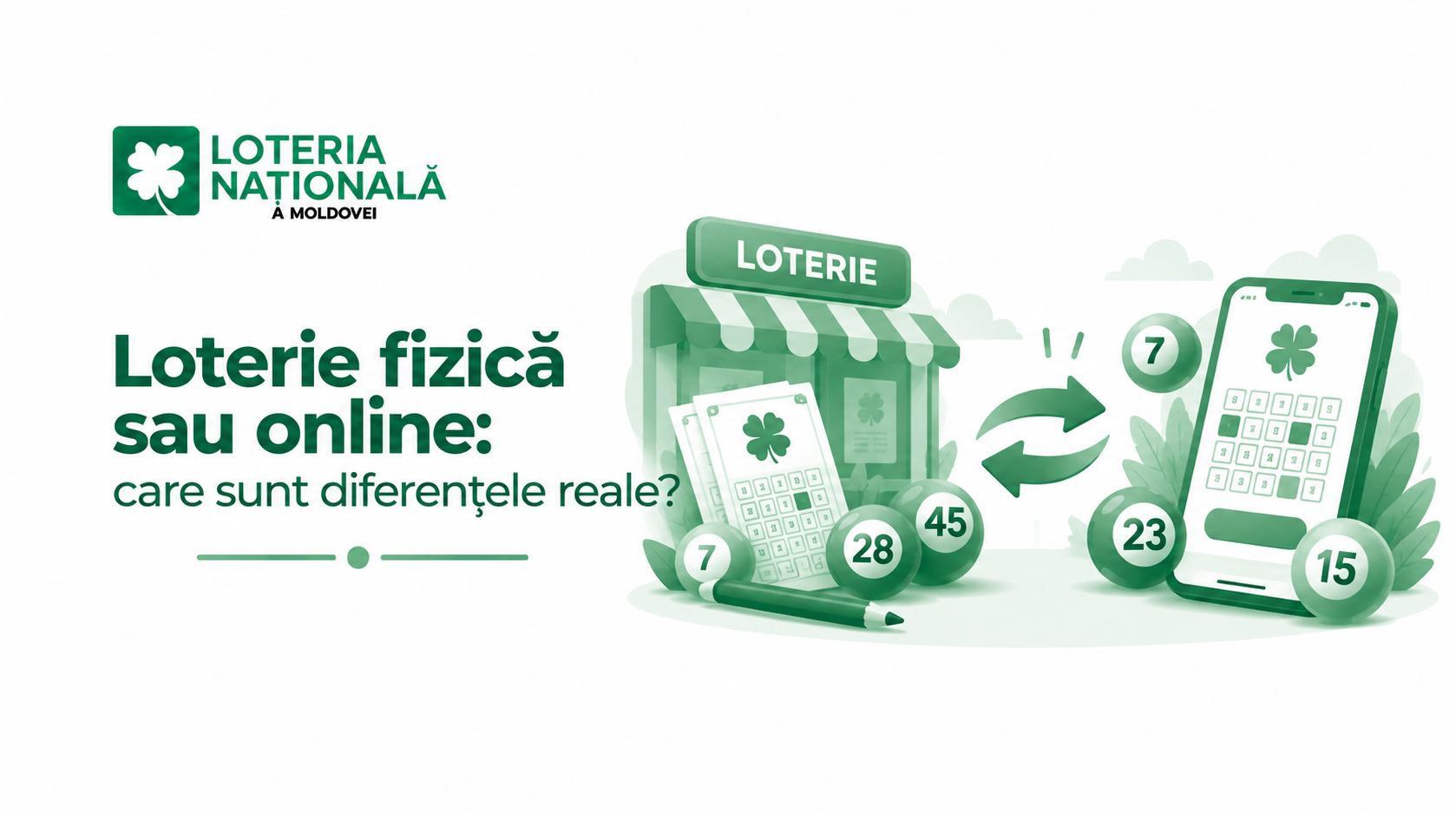
The question comes up often, and the answers that circulate usually mix up two different things: how you play and how much you win. Choosing a channel comes down to convenience and ticket safety, not the outcome of the draw.
This article compares the two options on the points that actually differ, without recommending either one. At the end there is a short checklist — the same regardless of where you buy your ticket.
This is the most important part, and also the most commonly misunderstood.
Odds. They are set by the game format — how many numbers are drawn and from what range. The channel through which you bought your ticket plays no part in that calculation.
The draw. There is only one, for all registered tickets, regardless of where they were purchased.
The rules. Prize tiers, the claim deadline, and payment conditions come from the game rules, not from the sales channel.
In other words, a ticket bought at a kiosk and one registered online enter the same draw, under the same rules, with the same odds.
This is where the first practical difference appears, and it is the most important one of all.
A paper ticket is generally a bearer document: whoever holds it can claim the prize. That means a ticket that is lost, accidentally washed in a pocket, or torn can become impossible to validate. The responsibility for keeping it safe falls entirely on the player.
With an account, your entry stays recorded in your account history. The ticket cannot be lost or damaged, and the result is tied to your account rather than a piece of paper. There is one other condition, though: you need to keep access to your account, with login credentials that no one else knows.
With a paper ticket, checking is something you have to remember to do. You do it at the point of sale or by comparing your numbers against the published result, and a large share of the world's unclaimed prizes comes from tickets that nobody ever looked at again.
In an account, the result appears in your history without you having to do anything, and small prizes are usually credited automatically. The difference is not in the odds — it is in how much you have to keep track of.
The claim deadline is the same, because it comes from the game rules. What differs is the path to the prize.
With a physical ticket, small prizes are usually paid at the point of sale, while larger ones require a visit to the location named in the rules, with the ticket and an ID. With an account, small prizes go into your account, and for larger amounts the procedure from the rules still applies, including identity verification.
Identity verification is not optional in either case. It is part of the legal framework that a licensed game operates within.
A real difference, but it cuts both ways. When buying a paper ticket you give no personal data, and you stay anonymous until the moment you claim a large prize.
An account, on the other hand, requires registration and age verification from the start. This is a legal requirement, not a formality of the website, and it is also what makes responsible gambling tools possible.
Cash has one simple advantage: it runs out. The amount you brought to the kiosk is exactly the amount you can spend that day.
With an account, payment is faster and less visible, which means your budget needs to be set in advance and tracked consciously. On the other hand, an account keeps a complete history of your entries — and that is the most honest report a player can read about their own gambling.
What to check, regardless of channel
Licence. The game must operate within a regulated framework, and that information is public.
Game rules. Prize tiers and the claim deadline should be read before the draw, not after.
Age. Participation in lotteries and sports betting is only allowed for people aged 18 and over, the same in both cases. For higher-risk games, the minimum age is 21.
Budget. The amount you set in advance stays the same, regardless of where you buy your ticket.
The difference between a physical lottery and an online one is not about odds — it is about logistics: how you keep your ticket, how you check the result, and how much you need to remember. The draw, the probabilities, and the rules are identical.
The choice comes down to personal preference. The National Lottery of Moldova operates within the state monopoly, with fixed odds and independent draws, and participation is only allowed for people aged 18 and over. The specific conditions are those set out in the game rules. Set a budget before you play, stick to it, and treat the lottery as entertainment.
1. Are the odds different online versus a physical ticket?
No. The odds depend entirely on the game format — how many numbers are drawn and from what range. The purchase channel has no effect on them.
2. Are separate draws held for online tickets?
No. There is only one draw, and all registered tickets take part in it, regardless of where they were purchased.
3. What happens if I lose my paper ticket?
A paper ticket is generally a bearer document, and without it claiming a prize is difficult or impossible. Check what the game rules say about this situation. With an account entry, the problem does not arise because your participation stays on record.
4. Is the claim deadline the same in both cases?
Yes. The deadline comes from the game rules, not from the sales channel. It is calculated from the draw date and is the same for all tickets.
5. Why do I have to verify my identity?
Because it is part of the legal framework that a licensed game operates within. It applies in both cases, and for large prizes it is required regardless of where the ticket was purchased.
6. Which option is better for budget control?
Cash limits spending naturally, because it runs out. An account, on the other hand, provides a complete history of your entries. In both cases, the budget you set in advance is the only tool that actually works.
Want to learn more?
You'll find guides, explanations and articles that help you understand how the games work before you decide.